
How do you do a DIY SEO keyword research?
This is part of the DIY SEO series on our web agency blog. It's a no BS article about how to handle your keyword research process.
How does a marketing funnel work?
Top •
Online conversion funnels: how to understand them, use and optimize a conversion funnel in your online marketing strategy.

A marketing funnel helps you find ways to reach your target audience, attract potential customers, turn them into qualified leads and hopefully turn them into clients!
The marketing conversion funnel is often described in a linear fashion with three phases:
Today , the reality is that the conversion funnel is not that linear. But these stages are a great visual representation of the process to transform leads into customers. Think of it as an inverted pyramid (or well, a funnel!). The online shopping journey is more robust.
Any good conversion funnel must take into account the different stages and touch points of the buying journey. Once these steps are highlighted, it is possible to better adjust your content strategy to generate quality traffic that will help you turn visitors into customers. A conversion tunnel makes it possible to analyze the points of friction (bounce rate, abandonment of basket, etc.). It also makes it possible to optimize the content creation process, to better target the types of content needed, etc.
To know more, contentsquare.com has a great article.
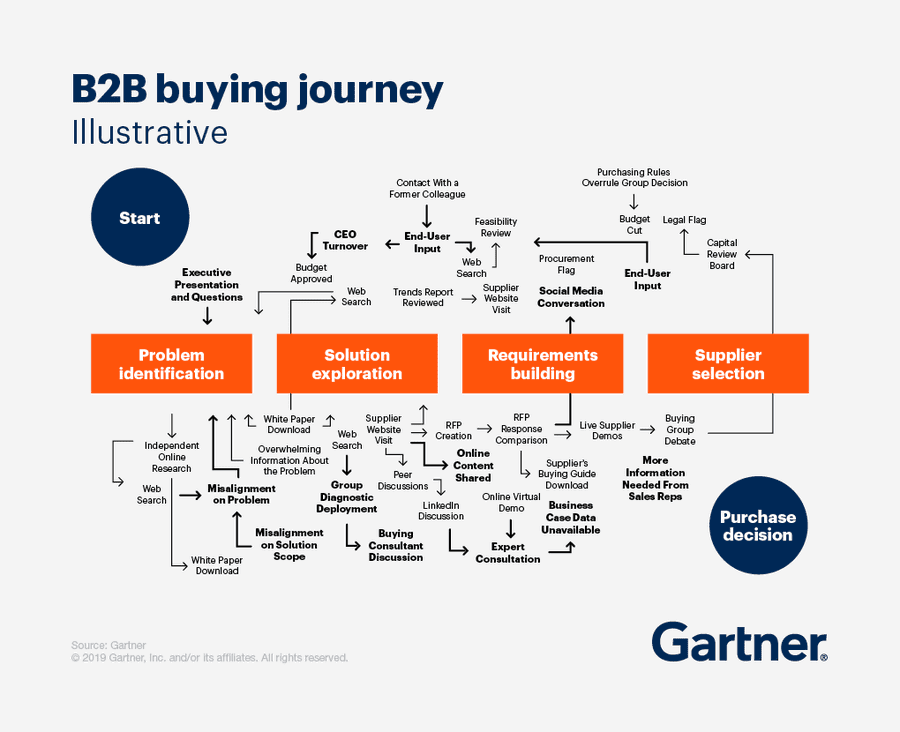
There are more sophisticated conversion tunnels that can be used. Conversion funnel optimization is a process that is very industry and often company specific. Here is a model, much more complex which captures the B2B reality. This is the Gartner model which is a modern B2B tunnel model. In this case, the buyer moves forward, backward and forward as they assess your product and navigate internal purchasing processes.
source: https://twitter.com/camden_gaspar/status/1336403278461022209
It may seem scary at first. But this is one of the examples of tunnels that reflects the reality of things.
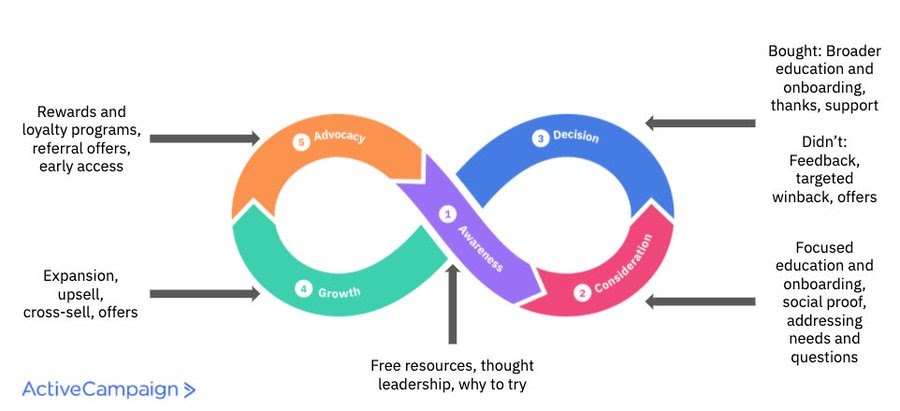
Source: https://twitter.com/BrendanHufford/status/1336404742860382208
Here is how he describes the entire funnel:
Let your marketer take the reigns to optimize your customer journey. Sometimes we can improve the conversion rate in an article! Most of the time, blog posts are created to attract new prospects. And content marketers rarely aim to convert users immediately, with just one blog post.
Usually the content is organized according to the different stages of the funnel, but in this video Tyler Hakes explains that in some cases you can move the buyer all the way down the funnel with just one very fleshed out blog post. Here’s a real-life example: a blog post from a SaaS company that turns 5% of readers into software subscriptions. Here is the user manual:
This poses a problem: the tedious process of creating and modifying sales sheets.
The article explains what automation means for your business and why automating sales sheets can be valuable for your business.
By moving the prospect from a stage of knowledge of the solution to that of the product. They don’t do anything complex. They simply explain how the product works and how to use it.
As Tyler Hakes said what it takes is mapping the different stages of the funnel that people go through - and the information they need as they go through their buying journey.
Do you think that better explains the funnel? What is your design for the funnel?
About the author
Augustin Delporte
Owner and operator of Pragm. GA4, Google Tag Manager, BigQuery, technical SEO, GEO and Google Ads consultant.
Augustin Delporte is a senior marketing expert who helps companies fix their analytics, SEO and Google Ads so they can trust their numbers and get found in Google and AI search.
This is part of the DIY SEO series on our web agency blog. It's a no BS article about how to handle your keyword research process.

Measure and improve user experience with Google Analytics. Here are the most important user metrics to analyze as a UX designer.